How to check your website's SEO health with an SEO checker
· 5 min read
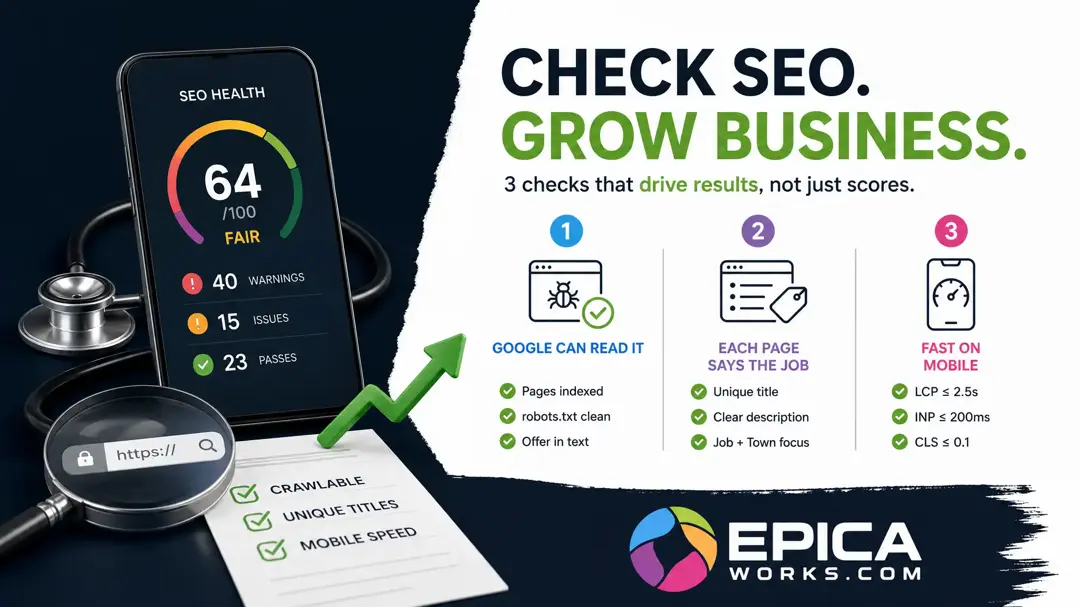
An SEO checker earns its keep on three problems: pages Google cannot read, titles that don't say what each page sells, and pages that crawl on a phone. Run those checks free in Google's own tools, fix them page by page, and treat the rest of the score as noise.
You pasted your address into a free checker and got a 64, a red gauge and forty warnings. Most of that list will not change a single call. The audit below is the short one a business owner can run in an evening, in the order that matters, with a way to tell each fix worked.
Make sure Google can read the pages that sell
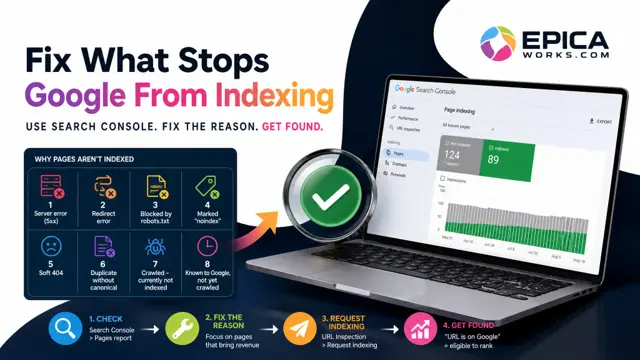
Start with the pages that bring paying work: the home page, each service page, the contact page. Search site:yourwebsite.com on Google and check that each of them appears. If one is missing, the Pages report in Search Console (under Indexing) gives the reason, and nothing else in this audit matters for that page until it is fixed.
Then open yourwebsite.com/robots.txt in your browser. A line reading Disallow: / under User-agent: * tells every crawler to stay out, and it is often left on from the week the site was built. Check that no rule names Googlebot or OAI-SearchBot, the crawler ChatGPT search uses to read sites. Blocking either one takes you out of that list of answers before anyone compares you with a competitor.
The last check here is the one checkers miss most: is your offer in text? Prices, services and the towns you cover often live inside a photo, a flyer or a PDF menu, where a crawler reads little or nothing. To test it, copy one sentence from your price section and search it on Google in quotes. If Google returns your page, the text is readable; if it cannot even be selected with the mouse, it is an image and needs retyping on the page.
Give every page its own title and description
Of all the warnings a checker prints, “duplicate title” is the one worth acting on first. The title is the blue line a buyer reads in the results, and Google's SEO Starter Guide says a good one is “unique to the page, clear and concise, and accurately describes the contents of the page”. Five pages all titled with your business name give Google five reasons to show none of them.
Rewrite each title around the job and the town, in the words a customer uses on the phone: “Water heater replacement in Orlando”, not “Home” or “Our services”. The meta description, the line under it, follows the same guide: short, unique to one page, with its most relevant points. Write the price range or the area there if you can state it honestly.
To check the result, run the site: search again a few weeks later and read the titles down the page as a stranger would. If two lines still look the same, Google has not picked up the change yet or it is still using another headline from the page.
Test the pages on a phone, with real visitor data
Most of your buyers will meet the site on a phone, so judge speed there. Search Console's Core Web Vitals report groups your pages as Good, Need improvement or Poor using data from real visits, and each group takes the status of its worst metric:
| Metric | What it measures | Good | Poor |
|---|---|---|---|
| LCP | how long the main content takes to appear | 2.5 seconds or less | over 4 seconds |
| INP | how fast the page reacts to a tap | 200 ms or less | over 500 ms |
| CLS | how much the layout jumps while loading | 0.1 or less | over 0.25 |
A small site often sees “No data available” there, because the report needs enough visits before it shows anything. In that case run each money page through PageSpeed Insights on the mobile tab, which tests in a lab instead, and send the items marked red to whoever builds your site, one page at a time.
The warnings you can leave alone
Checkers score things Google has said in writing it does not use. The same Starter Guide lists them as things not to focus on, and the length of a page is one of them:
The length of the content alone doesn't matter for ranking purposes
| Checker warning | What Google's guide says | What to do |
|---|---|---|
| Missing meta keywords | Google Search doesn't use the keywords meta tag | Nothing |
| Low word count | Length alone doesn't matter for ranking | Answer the buyer's question, then stop |
| Headings out of order | It doesn't matter for Search if they are out of order | Fix only if it confuses readers |
| Same page under several addresses | Inefficient, but not something that causes a manual action | Fix only if the wrong address shows in results |
| No keyword in the domain | Hardly any effect beyond breadcrumbs | Keep your name |
Which tool is best for an SEO audit?
For a site of a few dozen pages, the best tool is the pair you already have: Search Console for what Google holds and how it performs, PageSpeed Insights for a single page on a phone. Both are free and both come from the company whose results you want to appear in.
Paid site-audit tools such as Semrush Site Audit, Ahrefs Site Audit or Screaming Frog crawl every page in one pass. They earn their price on a site with hundreds of pages, an online shop, or a move to a new platform, where checking pages one by one is impossible. Their health score is the tool maker's own formula, so use the list of affected pages they produce, not the number at the top.
💡 When someone sends you an audit: ask which page each fix is for and what the page should say afterward. A report that lists forty warnings and no pages is the checker's output with a logo on it, not an audit.
This is not for you if every money page is indexed, each has its own title and the phone test is Good: an audit will not find what keeps the phone quiet, and running more checkers only moves the score.
This week, open your robots.txt, list the title of every service page in one column and rewrite the duplicates, starting with the service that pays best. When those pass and calls still don't come, the gap sits further along, in whether Google and ChatGPT name you at all, which is the last of the five checks for a website that brings no customers.