Questions
What keyword search volume can't tell you about buyers
· 3 min read
Most keyword advice starts with search volume: pick the searches with the biggest numbers. It makes sense, until you look at who is behind those numbers. Volume tells you how many people type a search, not whether any of them are ready to buy. When we measured 239 buyer needs across 17 trades in October 2026, a need's volume said almost nothing about how many of its searches came from buyers, and the needs full of people who are just learning are exactly the ones Google now answers with AI.
Do big searches bring more buyers?
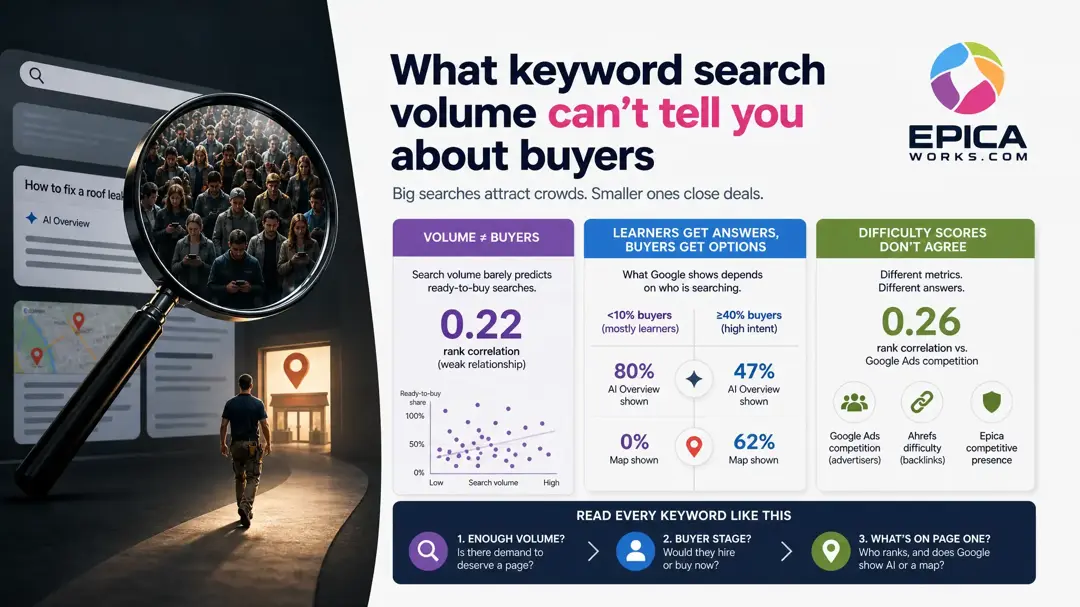
Not really. We sorted every search into four stages (learning, comparing, ready to buy, or looking for a provider) and compared each need's volume with its share of ready-to-buy searches. The two barely moved together: a rank correlation of 0.22, where 1 would mean they always rise together.
You can see it inside a single trade. In car care, the battery need has more searches than anything else on its card, yet only 6% of them come from people ready to buy. In machine tools, the opposite happens: the need with the most searches, used CNC machinery with a guarantee, is 75% ready to buy. And in roofing, someone searching how to fix a roof leak is ready to hire more than half the time (54%), while someone asking how to cool their attic almost never is (5%).
What happens to the searches full of learners?
Google increasingly answers them itself. Among the 111 needs where fewer than 1 search in 10 came from a buyer, in the typical need 80% of the results pages showed an AI Overview and none showed a map. Among the 65 needs where 4 in 10 or more were buyers, the typical need had an AI Overview on 47% of its results pages and a map on 62%.
In plain terms: a big learning search may get answered right on Google's own page, while a smaller buying search still sends clicks, often through the map.
Can you trust keyword difficulty scores?
Treat them with care, because each one measures something different. The “competition” column in Keyword Planner counts advertisers, not how hard it is to rank. The difficulty scores in paid tools count links: Ahrefs bases its score on how many websites link to the top 10 pages. Our own measure, the share of first-page results held by big sites that keep showing up across a trade's searches, barely agreed with Google Ads competition (a rank correlation of 0.26). Before trusting any score, look at the first page yourself.
So how should you read a keyword?
Ask three questions, in this order. Is there enough volume to deserve a page in your market? Google Keyword Planner answers that one. Would someone typing it hire or buy now? That is the stage. And who holds the first page today, and does Google show an AI Overview or a map there?
The needs of each trade, with their stage split and what Google shows for them, are on the industry cards of Epica.