Questions
How to do keyword research when 4 in 10 ideas are off-topic
· 3 min read
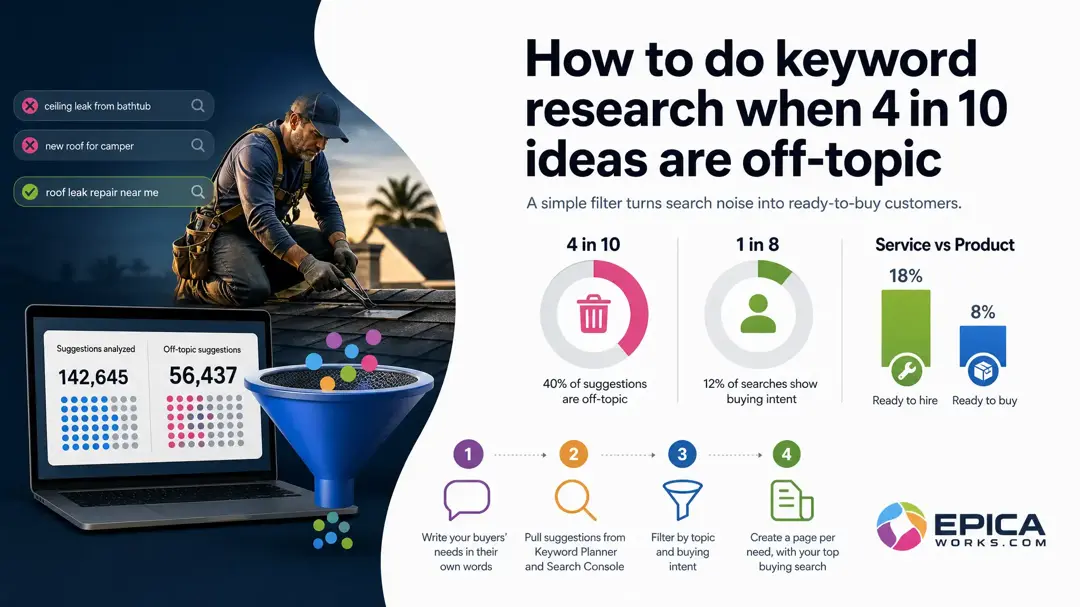
If you run a small business and have ever opened Google's keyword tool, you know the feeling: hundreds of suggestions, each with a tidy monthly number, and no idea which ones matter. When we went through those lists for 17 trades in October 2026, about 4 in 10 suggestions had nothing to do with what the buyer needed, and in a typical need only about 1 search in 8 came from someone ready to buy or hire. Keyword research for a small business is mostly one job: filtering.
Why does Google suggest searches your buyers never type?
Google Keyword Planner matches words, not intentions. Ask it about a Florida roofer fixing a roof leak and it adds “ceiling leak from bathtub”, which is a plumber's job. Ask about the cost of a new roof and it offers the price of a new roof for a camper. A car-care brand looking at battery searches gets lists of jump starters by store, and a CNC lathe maker gets used milling machines.
From Google's side nothing is wrong: the words overlap. But none of those people will ever call you. Across the 239 buyer needs we measured, we threw out 56,437 of the 142,645 suggestions, more in Spain (43%) than in Florida (37%).
The fix is one question you ask of every suggestion: would someone with this need really type this? If the answer isn't a clear yes, it goes.
How do you tell a buyer from someone who is just reading?
Search volume tells you how many people type something, not who they are or how close they are to deciding. So we sorted every search we kept into four stages: learning, comparing, ready to buy, or looking for a provider.
The gaps were bigger than we expected, even inside one trade. Someone searching how to fix a roof leak is ready to hire more than half the time (54%); someone searching how to cool their attic almost never is (5%). In machine tools, three out of four searches for used CNC machines with a guarantee come from buyers, while only one in twenty searches about CNC lathes do. And in car care, the battery need has more searches than anything else on its card, yet only 6% of them come from people ready to buy.
There is a wider pattern too: people looking for a service tend to be closer to deciding than people looking for a product. In the typical need, 18% of searches were ready to hire across our 12 service trades, against 8% ready to buy across our 5 product trades.
What to do with that: point the ready-to-buy searches at your service and product pages, and answer the learning ones in guides.
What does the whole method look like?
Four steps, in this order:
- Write down your buyers' needs in their own words, one for each problem you solve.
- For each need, pull the suggestions from Keyword Planner, plus the searches you already show up for in Google Search Console.
- Run both filters: is it on topic, and how close is the person to buying?
- Give each need its own page, with its biggest ready-to-buy search in the title.
Can AI do the filtering for you?
Partly. The sorting, yes: we classified all 142,645 suggestions with a language model, one need at a time, and then checked by hand what slipped through before publishing each card. The numbers, no: a chatbot has no idea how often something is searched, so the volumes still have to come from Keyword Planner or a paid tool.
If you would rather start from lists that are already filtered and split by stage, every industry card on Epica shows them for its trade.