Questions
Is SEO dead if ChatGPT recommends a different list than Google?
· 2 min read
No. Keep the SEO work, because ChatGPT writes its answers from pages a web search finds, and Google's AI answers run on the same groundwork. What you add is a second check: ask ChatGPT your customers' question, see who it names, and get onto the sites it cites.
A customer tells you she asked ChatGPT for a roofer before calling around, and it named two of your competitors. The worry that follows is fair: if people now ask a chatbot, was the money you put into Google wasted? It was not, but her story tells you which list you have been watching and which one you have not.
Why your Google work still counts in ChatGPT
When someone asks ChatGPT about current options, such as a roofer in their town, it runs a web search, reads a handful of the pages it finds and builds the answer from them. A page no search can reach never gets read, so SEO, the work of making your site easy for search engines to find and understand, still decides whether you are in the pile.
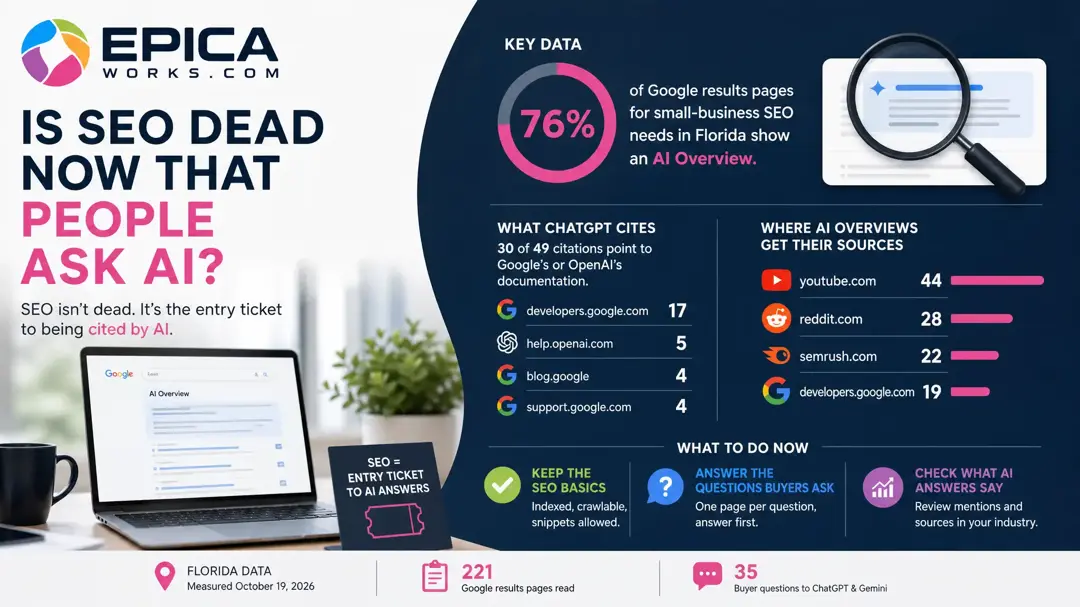
Both companies say so in their own documentation. OpenAI's page on its crawlers says a site that opts out of OAI-SearchBot, its search crawler, is left out of ChatGPT's search answers. Google's page on AI features and your website says the best practices for SEO remain relevant for AI Overviews and AI Mode, with no additional requirements to appear in them.
So the basics stay on your list, and each one can be checked in minutes:
- Your robots.txt (open yoursite.com/robots.txt in a browser) does not block OAI-SearchBot or Googlebot.
- Each service has its own page with a clear title, not one page called “Services”.
- Prices, services and the area you cover are written as text, not only inside photos or PDFs. If you can't select the words with your cursor, a search can't read them either.
Two lists, not one
What did change is who gets named. Ranking well on Google does not carry over into ChatGPT's answer. Across seven US trades we measured in October 2026, only 6 of the 70 sites ChatGPT cited most were also among Google's click winners, the 10 sites that take the most clicks in each trade.
That is why the customer's story can be true while your Google rankings look fine. ChatGPT leans on directories, associations, review sites, local press and guides, and names the businesses those sites mention. Your own page is one source among several, and often not the one that decides.
The practical consequence is that you now check two lists, with two different questions. On Google you ask: where does my page rank for this search? In ChatGPT you ask: which businesses does the answer name, and which sites did it read to name them?
What to do in each case
Take a first reading before you change anything. Log out of ChatGPT, then type five questions the way your customers ask them on the phone, with your town in each: “Who's the best roofer in Plano for hail damage?”, not “roofing services”. Do the same in Gemini, because the two cite different sites. Then search the same words on Google and set the lists side by side.
| What you see | What to do this month |
|---|---|
| On Google, not in ChatGPT | Keep the SEO; get listed on one site ChatGPT cited |
| In ChatGPT, not on Google | Fix the basics above, then one page per question |
| On neither | Start with robots.txt and your service pages |
| On both | Repeat the same five questions every month |
One answer is one draw: ChatGPT can name different businesses for the same question on another day. Write the date next to each reading and repeat the same questions before you decide anything on the strength of one chat.
When you don't need this: if word of mouth keeps you booked weeks ahead, or you work a single small town where your Business Profile on Google already brings the calls, the second list can wait.
Can ChatGPT do SEO?
It can do part of the work you would otherwise pay for. Paste a service page into ChatGPT and ask it which questions a customer would still have after reading it; you will get a usable list of the missing answers in a minute. It can also draft that answer, suggest page titles and explain what a line in your robots.txt does.
What it cannot do is measure. It does not know which searches your buyers type, where your pages rank, or which businesses it names to other people, because none of that is inside your conversation. A chat run while you are logged in is also shaped by your own history, which is why the reading above is done logged out. Use ChatGPT to write; use the dated reading to know.
What to ask whoever does your SEO
If you pay someone for SEO, the money is not wasted, but the brief has grown. Google's own page on whether you need an SEO says no one can guarantee a #1 ranking on Google, and the same holds for a place in ChatGPT's answer. So ask for tasks, not rankings, and keep the accounts (Search Console, your Google Business Profile, the domain) in your own name.
Three questions are enough to tell whether your provider has caught up:
- Which sites did ChatGPT and Gemini cite for our five main customer questions last month?
- Are we listed on any of them, and if not, which one are we working on?
- What does Search Console's Generative AI performance report show for our pages in AI Overviews and AI Mode?
Before your next SEO invoice, send those three questions by email. If the answers come back vague, run the five-step ChatGPT check yourself; the first step, the robots.txt check, takes a minute.