How to write SEO content that ranks and gets cited by AI
· 5 min read
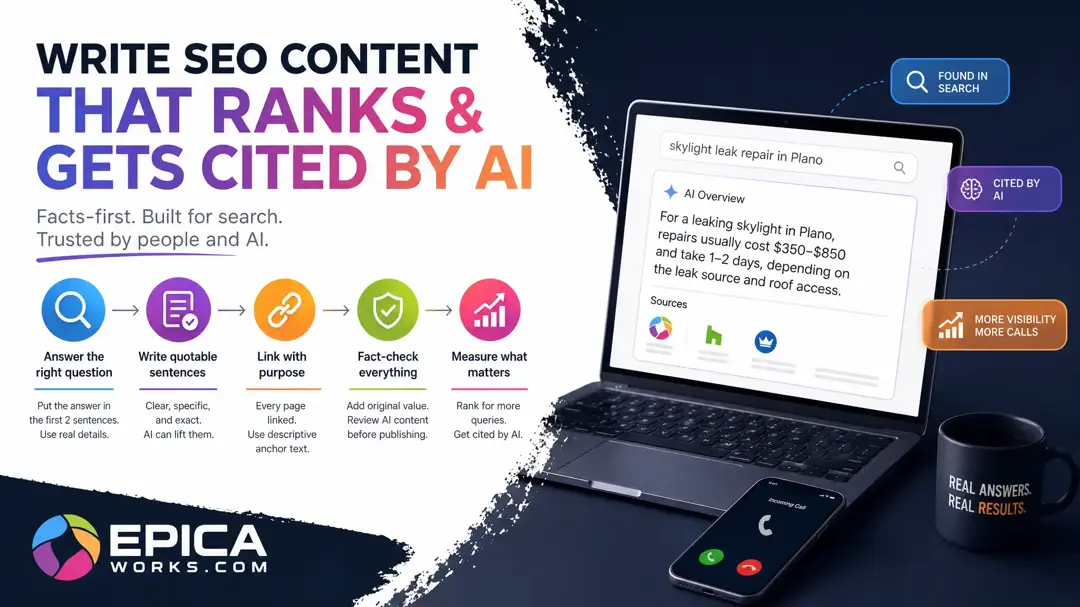
Write each page around one buyer question, answer it in the first two sentences with facts only you have, and link to it from related pages in plain words. ChatGPT can draft that page, as long as you check every fact before it goes live.
You have a service page that gets visits and no calls, or an empty page and one evening to fill it. Most advice on SEO content writing argues about word counts and keyword density, or about a special style “for AI”. Google's own documentation asks for something simpler, and every step below comes from it or from how we check pages ourselves.
Build the page around one question
Pick the question a buyer asks before calling you, the one you answer on the phone every week. Choosing which question earns a page first is the subject of our guide to what to publish; here the question is chosen, and the job is the page.
Make the title that question, in the customer's words, with your town in it if you serve one area. Google's SEO starter guide says a good title “is unique to the page, clear and concise, and accurately describes the contents of the page.” “Can a leaking skylight be repaired, or does it need replacing?” passes that test; “Skylight Services” does not.
The first two sentences give the answer, whole: what usually happens, what it depends on, and your range or timeframe. Then each heading below them is the next thing a caller asks once they have the answer: what it costs, how long it takes, what can go wrong, when to call someone. The same guide says the length of the content alone doesn't matter for ranking, so stop when the caller's questions run out.
Check it: read the title and the first two sentences aloud to someone outside your trade. If they can repeat the answer back with a place and a range, the page has its spine.
Write sentences an answer can lift
Google's summaries and ChatGPT's answers tend to quote a passage, not a page. A sentence that starts “As mentioned above, this…” cannot travel on its own; a sentence that names the job, the town and the condition can. So open every paragraph with its point and name the thing instead of writing “it”.
Fill those sentences with what only you can say: what pushes your price up, the jobs you turn down and why, the permit you pull, how many days pass from the first call to the finished job, a photo of a real job with a caption saying where and when. A competitor can copy your headings; nobody can copy your invoices.
Use the customer's words where they belong (the title, the first sentence, one heading) and then write normally. Google's guide warns that repeating the same words over and over, even in variations, is tiring for users, and a reader who is tired leaves before the phone number.
To test the page against an AI answer, ask the way your customers do: log out of ChatGPT, type the page's question with your town, and note which sites the answer cites. If the answer says something your page does not, that gap is your next paragraph.
Link each page from the pages that lead to it
An internal link is how both a reader and Google get from one of your pages to another. Google's link best practices put the rule in one line: “Every page you care about should have a link from at least one other page on your site.”
A simple shape works for most small sites. The home page links to each service page. Each service page links down to the question pages that belong to it, and each question page links back up to its service and across to the one sibling a reader would want next. A roofer's “skylight leak” page links to the repair service page and to the “roof inspection before you sell” page, not to every page on the site.
Write the anchor text, the clickable words, as the name of the page it opens: “skylight leak repair in Plano”, never “click here” or “learn more”. Google suggests reading only the anchor text, out of context, to check it is specific enough to make sense by itself. On how many links a page needs, the same page says there is no magical ideal number, and “if you think it's too much, then it probably is.”
Check it: in Search Console, open the Links report and its Internal links table, which lists your pages by how many links they get from the rest of your site. A new page missing from that list has no link from your site yet.
Can ChatGPT write SEO content?
It can write the draft, and Google does not object to how a page was made. Its guidance on using generative AI content says “Generative AI can be particularly useful when researching a topic, and to add structure to original content.” The same page sets two limits: generating many pages without adding value for users may break its policy on scaled content abuse, and “It is critical to manually factcheck and review all AI-generated content for accuracy and trustworthiness before publishing,” titles, meta descriptions and image alt text included.
That gives a working order. Give ChatGPT your own material first: the question, your answer the way you say it on the phone, your price range, the area you cover and two real jobs. Ask for a page with the answer in the first two sentences and one heading per follow-up question, then ask what a customer would still want to know after reading it.
Then edit as the owner. Trace every number, town, permit and promise to your own records, and strike what you cannot back. Delete any sentence that would fit a competitor's page unchanged, and replace it with a fact from a job you did.
💡 The borrowed sentence: if ChatGPT writes that you “pride yourselves on quality service”, that line came from other people's websites. Swap it for one thing a customer told you after a job.
Who can skip this, and how to tell it worked
Skip the writing if referrals fill your calendar weeks ahead, or if your site does not yet have one page per service: those pages come before any question page.
For everyone else, the check comes a month after the page goes live. In Search Console's Performance report, filter by the page and read the queries it now shows for; the words people used tell you whether the title matched them. Then ask ChatGPT the page's question again, logged out, three times on different days, and date each reading, because one answer is one draw.
Tonight, take the page customers phone you about most, rewrite its title as their question and its opening as your answer, and link to it from your home page with those same words. Which question comes after that one depends on your trade, and the questions buyers put to Google and ChatGPT are measured on your industry's card.