What AI visibility tools measure, and why the prompts matter more
· 5 min read
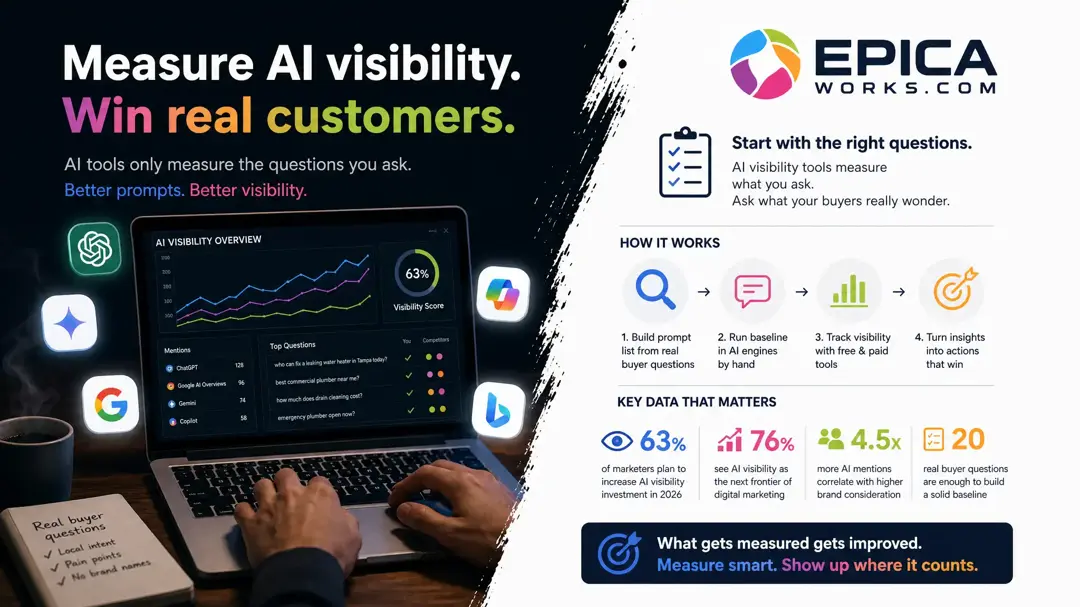
Clients now ask their agency whether they show up in ChatGPT. AI visibility tools answer by asking ChatGPT, Gemini and Google the same questions every week and counting mentions. But a tool only measures the questions you feed it, so write your client’s real buyer questions first.
Google and Bing also report how often your pages appear in their AI answers, for free. This post shows how to set up that monthly check before paying for anything.
Turn on the two free reports first
Both engines that publish their own AI data give it away, and nobody can argue with the source.
Google's Generative AI performance report sits under Performance in Search Console. It counts impressions: how many times a link to the client's site was shown in an AI Overview or in AI Mode, grouped by page, country, device and date. Google says it rolled the report out to all websites on August 31, 2026. It reports no clicks, so read it as exposure, not traffic.
Bing's AI Performance report in Bing Webmaster Tools, in public preview since February 2026, counts citations instead: how often the client's pages appear as sources in Microsoft Copilot, Bing's AI summaries and select partner integrations. It lists the cited pages and the grounding queries, the phrases the AI used to retrieve the content, and Microsoft notes that citation counts do not indicate ranking or authority.
Add the client as a verified property in both today, so a baseline starts counting while you decide on anything paid. What neither report shows is ChatGPT, Gemini or Perplexity, and neither names the competitors that appeared where your client did not. Those two gaps are what the paid tools sell.
Build the prompt list before any dashboard
Every tracker asks for the prompt list on day one, and most agencies write it at a desk from the kickoff call. Take it from evidence instead:
- Search Console queries for the client's site that read like questions.
- The “People also ask” boxes on the client's three or four main searches.
- What the client's front desk or sales team hears before someone books.
Keep twenty, written the way a buyer types them, with the city where the client sells. A plumbing client's list has “who can fix a leaking water heater in Tampa today,” not “best plumber.” Leave the client's brand name out of all of them: a prompt with the brand in it measures whether the engine knows the brand, not whether it recommends the business to someone who has never heard of it.
The check is simple. Show the list to the client and ask which questions they have heard from a customer in the last month. Any question nobody recognizes gets replaced.
Run the baseline by hand
Before any tool, run the twenty questions yourself in ChatGPT, Gemini and Google, logged out, in a private window. Keep a sheet with four columns: the question, the engine, the date, and every business and source the answer named. Twenty questions on three engines is sixty answers, an afternoon's work.
One run of a question is a single draw: the next run can name different businesses, so a screenshot of one chat shown to a client proves nothing. Run the whole sheet again four weeks later, with the same wording, and date every row. Mark each row where a competitor is named and your client is not.
Those two dated sheets are the client's baseline. They also tell you which engines matter for this client, which is the first thing any tracker will ask you to choose.
Which tracker fits which client
Each paid tool runs your prompts through answer engines on a schedule and records mentions, citations and competitors. They differ in the engines covered, the prompts a plan holds and the pricing unit. Prices as listed on each vendor's own pricing page on November 6, 2026; check again before buying, since these pages change often.
| Tool | Engines named | Prompts in the entry plan | Listed price |
|---|---|---|---|
| Peec AI | 3 chosen from ChatGPT, AI Overviews, AI Mode, Gemini, Copilot and Naver AI | 50, daily | Starter $95/mo |
| Semrush AI Visibility Toolkit | ChatGPT, Google AI, Gemini, Perplexity | 25, daily | $99/mo per domain, yearly |
| Ahrefs Brand Radar | Google, ChatGPT, Gemini, Perplexity, Copilot, Claude | Your own, or an index of 538M | From $50/mo; index from $199/mo |
| Profound | ChatGPT, Gemini, AI Overviews on the trial | 50, daily for 7 days | Trial; enterprise custom |
Read it by situation. One local client with a list of twenty: the hand sheet plus the free reports may be enough, or the smallest plan that covers the engines your baseline showed. Ten clients: the pricing unit decides, because Semrush charges per domain, so ten clients means ten licenses, while Peec states volume as prompts times models times days, 4,500 AI answers a month on Starter. Pitching a prospect you have not signed: a prebuilt index like Ahrefs' needs no setup, though a small local business that no answer names yet will find little about itself in it.
What to tell the client each month
Google draws the line on what any of these tools can know, in its guide to optimizing for generative AI features:
No third-party tool has access to our internal ranking or AI systems.
So a tracker reports what answers said, never why. Treat any vendor claiming to know which “ranking factors” moved a client in ChatGPT the way you would treat an SEO tool claiming Google's internal data.
The monthly report then has three lines: the free reports' trend for the client's pages, the rows where a competitor was named and the client was not, and the one source cited in those rows that the client could get listed on next month. That last line turns a measurement into a task. If you want a measured starting list rather than one you build, Epica's free analysis runs a question set for a single site.
This week, pick the client most likely to ask about ChatGPT on the next call, pull their twenty questions from Search Console and their front desk, and block an afternoon to fill the first sheet.