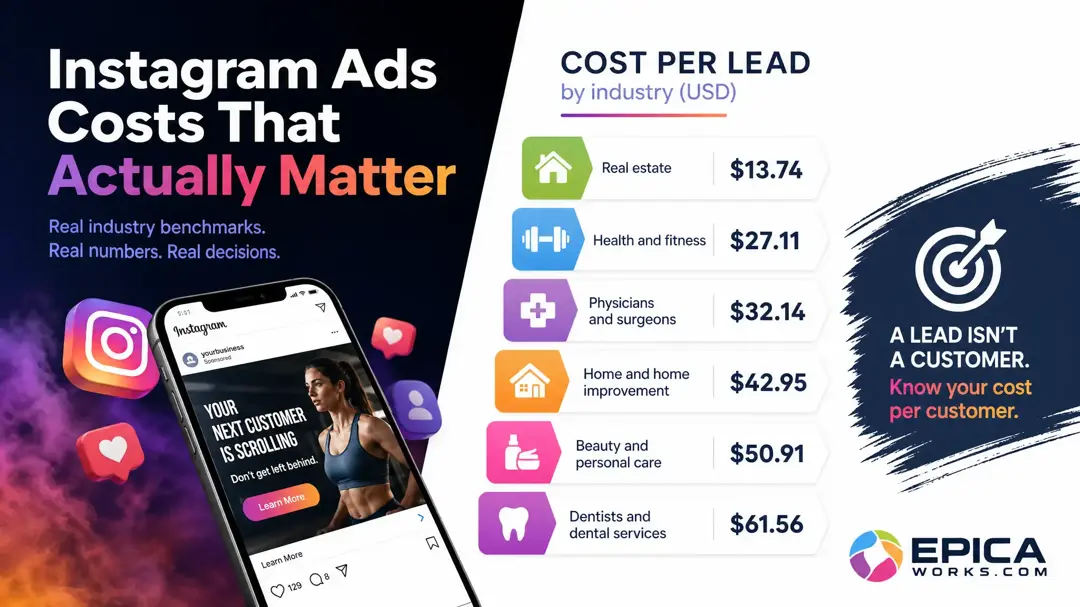
In the US, a lead from Instagram and Facebook ads costs about $14 to $62 by industry, but what decides whether it pays is what you spend per customer. Meta doesn't price Instagram apart from Facebook, so the published figures cover both.
What a lead costs in each industry
The broadest public figures are LocaliQ's Facebook advertising benchmarks, updated in September 2026: lead campaigns across 20 industries averaged $27.39 per lead and $1.80 per click. A lead there is someone who fills in a form, and each figure is an industry average, not a price you'll be quoted.
| Industry | Cost per lead |
|---|---|
| Real estate | $13.74 |
| Health and fitness | $27.11 |
| Physicians and surgeons | $32.14 |
| Home and home improvement | $42.95 |
| Beauty and personal care | $50.91 |
| Dentists and dental services | $61.56 |
Real estate has the cheapest lead because its forms ask for very little (a home valuation, new listings by email), which tends to bring in people still months or years from moving. Expect fewer of those leads to become clients.
There's no published figure for alarm and security companies: no study breaks the industry out. The only figure worth planning on is your own, and two or three weeks of a campaign give it to you with the steps below.
A cheap lead isn't a cheap customer. A gym lead at $27 that never answers the phone costs more than a $62 dental lead who books a cleaning.
If you sell products, watch the cost per sale
For car care products or cleaning sprays and air fresheners, the ad isn't after a lead: it's after a purchase. Triple Whale's Meta benchmarks, from more than 40,000 online stores between August 2025 and July 2026, put the median cost per purchase at $38.99, with $1.88 in sales for every dollar of ads.
Home and garden, where cleaning sprays and air fresheners sit, costs more: $47.93 per purchase, on an average order of $110.41, with $2.25 in sales per ad dollar. The report has no automotive category, so car care has only the overall figure to go on.
| What you sell | Meta cost per purchase | Sales per ad dollar |
|---|---|---|
| All online stores | $38.99 | $1.88 |
| Cleaning sprays and air fresheners (home and garden) | $47.93 | $2.25 |
A $110 order is not a $7 can of air freshener. What tells you how much you can pay is your margin: if you keep $4 on each sale after the product and shipping, you can't spend more than $4 in ads per sale. If your margin is half the price, every ad dollar has to bring in $2 of sales just to break even.
A single bottle of car shampoo or one air freshener rarely pays for its ad on the first order. The bigger order and the second purchase do: a complete wash kit, a three-pack of sprays, an email when it's time to restock. Track the cost of the first order, and separately how many of those buyers come back within three months.
How to work out what it costs you
- In Meta Ads Manager, open the campaign and click Breakdown, By delivery, Platform. You'll see Instagram and Facebook side by side, each with its own cost per result.
- For 30 days, log every lead or order in a sheet: whether they picked up the phone, asked for a quote or a visit, and bought.
- Divide what you spent by the number who bought. That's your cost per customer, the only figure you can set next to what a customer is worth to you.
- Compare it with what that customer brings in over a year, not just the first sale: an alarm with a monthly monitoring fee, or a buyer who restocks every season, can carry a much higher cost per customer.
Run the same count every month, the same way, and compare it with last month before you touch the budget.
💡 For alarm companies: add two screening questions to the lead form, home or business and own or rent. You'll get fewer leads, but when you call you'll already know which system to offer and who not to call.
Who gets the customer who never sees your ads?
You pay for an Instagram lead every time; the customer who finds you on Google, or whom ChatGPT points to your company, costs you nothing per click. Before you raise the budget, ask the way your customer would, logged out, in ChatGPT and in Gemini: “which alarm company do you recommend in Tampa” or “what's the best car wax”. Write down who they name and which sites they cite.
One answer proves nothing, because it changes from day to day. Repeat the same questions on two or three days and note the date of each.
If they recommend someone else, those customers are buying without ever passing your ads: check who Google and ChatGPT recommend in your industry before you pay more for each lead.