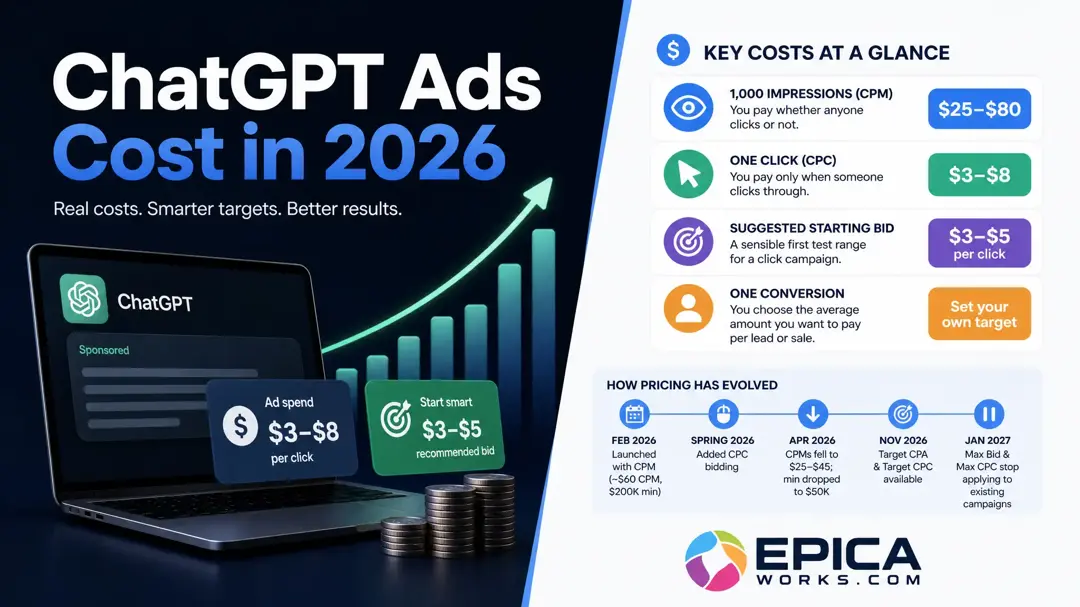
In the US, a click from a ChatGPT ad costs about $3 to $8, while 1,000 impressions cost roughly $25 to $80. But what decides whether it pays is not the click: it is what you spend to win a customer.
ChatGPT Ads is still new, and OpenAI does not publish a rate card or official performance benchmarks. The figures below are early market data, so treat them as a starting budget, not a quote. OpenAI’s Ads guide explains the available buying options; early performance data is still limited.
What a ChatGPT ad costs
ChatGPT Ads can be bought by impressions, clicks, or conversions. In practice, most advertisers now buy clicks or optimize for a conversion, because that ties spend more closely to an action. OpenAI introduced click-based buying after launching with CPM pricing.
| What you buy | Typical cost | What it means |
|---|---|---|
| 1,000 impressions (CPM) | $25–$80 | You pay whether anyone clicks or not. |
| One click (CPC) | $3–$8 | You pay only when someone clicks through. |
| OpenAI’s suggested starting bid | $3–$5 per click | A sensible first test range for a click campaign. |
| One conversion | Set your own target | You choose the average amount you want to pay per lead or sale. |
OpenAI recommends starting with a maximum bid of $3 to $5 per click. Real accounts have reported higher costs: one agency reported a $50.15 CPM and $7.64 per click across $27,684 of spend between June and November 2026.
The important distinction: a conversion-optimized campaign is not necessarily charged per conversion. OpenAI says these campaigns can still bill for valid clicks, while the system optimizes delivery toward the conversion event.
How the pricing has changed
ChatGPT Ads began as an invitation-only, impression-based product with a reported CPM near $60 and a $200,000 minimum commitment. It has since opened up, added click-based buying, and lowered the practical entry point.
| When | What changed |
|---|---|
| February 2026 | Ads launched with CPM pricing; reported CPM was about $60, with a $200,000 minimum commitment. |
| Spring 2026 | OpenAI added CPC bidding, so advertisers could pay for clicks rather than impressions. |
| April 2026 | Reported CPMs fell to roughly $25–$45, and the minimum commitment reportedly dropped to $50,000. |
| November 2026 | New campaigns can use Target CPA for conversions or Target CPC for clicks. |
| January 2027 | Max Bid and Max CPC are scheduled to stop applying to existing campaigns. |
That shift matters: instead of manually capping every bid, you can now tell ChatGPT Ads the average cost you are willing to accept for a click or a customer action. The platform then manages individual bids toward that target.
What a click is worth
A ChatGPT click is not automatically a Google Search click.
Early ecommerce data found that a paid ChatGPT visit generated $0.89 in revenue per session in the US, compared with $2.45 for a paid Google Search visit. Transactions per session were 0.37% for ChatGPT ads, against 1.17% for paid search. The study is summarized by Search Engine Journal.
| Metric | ChatGPT Ads | Paid Google Search |
|---|---|---|
| Revenue per session | $0.89 | $2.45 |
| Transactions per session | 0.37% | 1.17% |
| Reported CPC in one agency account | $3.14 | Not stated in the same study |
That does not mean ChatGPT ads are bad. It means a ChatGPT click may arrive earlier in the research process, with less purchase intent than someone typing a high-intent search query. The opportunity is to use ChatGPT to reach people who are actively asking for recommendations, comparisons, and local options—not to copy a Google Search campaign and expect the same result.
How to work out what it costs you
- Start with a click campaign at a $3–$5 maximum bid, or set a Target CPC if that is available in your account.
- Run it for at least two to three weeks before judging it. Early delivery can be uneven.
- Track every lead or order in a sheet: whether they called, requested a quote, booked, or bought.
- Divide total ad spend by the number of customers, not the number of clicks. That is your cost per customer.
- Compare that cost with the margin or lifetime value of the customer.
A $5 click is cheap if one in ten clicks becomes a $500 customer. It is expensive if you need 200 clicks to make one sale.
💡 For local service businesses: ask ChatGPT, logged out, “which [your service] company do you recommend in [your city]?” Repeat the question on two or three different days. Note which companies it names and which websites it cites. That shows you who is getting recommended before you spend on ads.
Who should test it now
ChatGPT Ads is most interesting for businesses whose customers ask questions before choosing:
- Local services: “Which alarm company do you recommend in Tampa?”
- Professional services: “What is the best accounting software for a small law firm?”
- Considered purchases: “What is the best car wax for a black car?”
- B2B software: “Which CRM is best for a small agency?”
The advertisers seeing the clearest early advantage are those who can answer the question a customer would actually ask, then make the next step obvious: get a quote, book a visit, request a demo, or buy the right product.
What to do before raising the budget
Before increasing spend, check whether ChatGPT already recommends a competitor when customers ask about what you do. If it does, those customers may be choosing without ever seeing your ad.
Run the same customer questions in ChatGPT and Gemini on several days, record the answers, and see which companies and sources appear. Then decide whether the priority is paid ads, improving the content ChatGPT cites, or both.
ChatGPT Ads is still early. The businesses that win will not be the ones that spend the most on the first day; they will be the ones that measure cost per customer and adjust before the budget grows.