Questions
Should you hire an AI search optimization agency?
· 5 min read
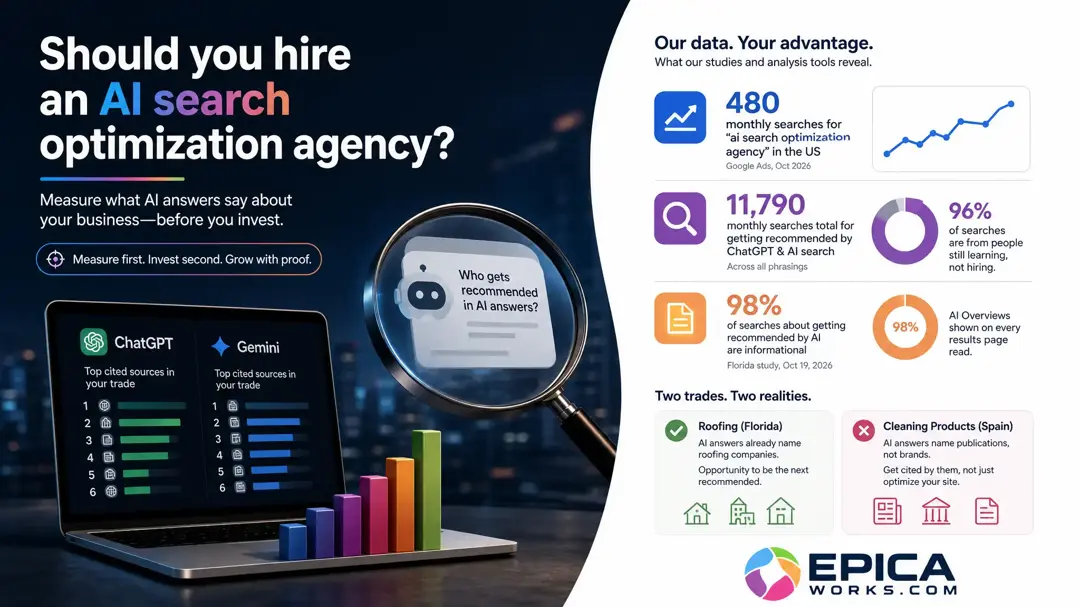
Hire an AI search optimization agency only after you have checked who ChatGPT names for your trade and can tell what the agency would change. If businesses like yours are named, the work is pages you can mostly do yourself; if only directories and media, it is getting mentioned there.
If you have paid for marketing before and got traffic graphs instead of clients, this is the same pitch with a new name, and the same rule applies: know where you stand before anyone sells you the fix. The steps below take an afternoon and cost nothing.
What the agency would actually do
Whatever the pitch calls itself, a generative engine optimization agency or an answer engine optimization agency, it sells ordinary search groundwork aimed at a new target: getting the business named inside the answer. In practice that is three jobs. Pages that answer the questions buyers ask, a site the engines' crawlers can read, and mentions of the business on the sites the answers cite.
Some proposals add special files “for the AI.” Google's page on AI features and your website is plain about its own answers: “You don't need to create new machine readable files, AI text files, or markup to appear in these features.” When a proposal lists one, ask what it is for and which engine reads it, and strike it if the agency cannot say.
Check who gets named in your trade before the call
This is twenty minutes of your own time. Open a private window, stay logged out, and ask ChatGPT and Gemini five questions a customer asks before calling a business like yours, with your town in each. Under every answer, write down the businesses named and the sites cited. If your trade has a card in the industries directory, it lists the sites both assistants cite most, with the date they were read.
Then find your row:
| What the answers name | What the work is | Who can do it |
|---|---|---|
| Businesses like yours | Pages that answer buyer questions, a readable site | You, or help you can check |
| Directories and associations | Claim listings, join, collect reviews | You, without an agency |
| Newspapers and magazines | Getting an editor to write about you | Where paid help can earn its fee |
| Only official sites | Your own pages carry the weight | You, starting with one page |
The table is the whole decision. An agency is most useful in the third row, where getting in takes editor contacts, and least useful in the second, where a listing is claimed by the business itself and an association is joined, not pitched.
You may not need any of it. If referrals and repeat customers fill your calendar, or you serve one small town where a complete Google Business Profile with recent reviews already brings the calls, the money is better kept.
Questions to put to the agency in writing
Ask by email, so the answers can be compared later:
- Which names do the answers give today for my trade and town, and how did you read them: how many questions, which engines, which dates?
- What will your work change in that picture, which pages and which cited sites, and how will I see the change on the next reading?
- What are the tasks, month by month, and whose name are the accounts and the website in?
A firm that measured your trade before writing to you will have the first answer ready. One that did not has sent the same email to every business on its list.
Listen for promises. Google's own page on whether you need an SEO says it flatly: “No one can guarantee a #1 ranking on Google.” Nobody controls which names an AI answer gives either, so a firm promising you a place in ChatGPT is selling something it does not own. Ask for the tasks, not the ranking, and keep every account in your own name.
How to tell the work is working
Agree on the check before you sign. The same five questions, asked the same way, logged out, once a month, with the date and every name written down. One answer is one draw, so a single screenshot of ChatGPT naming you proves nothing; the comparison between two dated readings does.
Ask the agency to bring that comparison to each monthly call, next to the tasks it finished. If the report shows traffic graphs and impressions but never says who the answers named this month against last, you are back where the last agency left you.
Three months is a fair first window. By then a listing should be live, a page should be published, and the readings should show whether the sites you targeted are cited and whether you are named on them.
This week, reply to the agency's email with the three questions above and hold the call until the written answers arrive.