Epica
Epica Measures What Buyers Search and Ask AI, Need by Need
· 3 min read
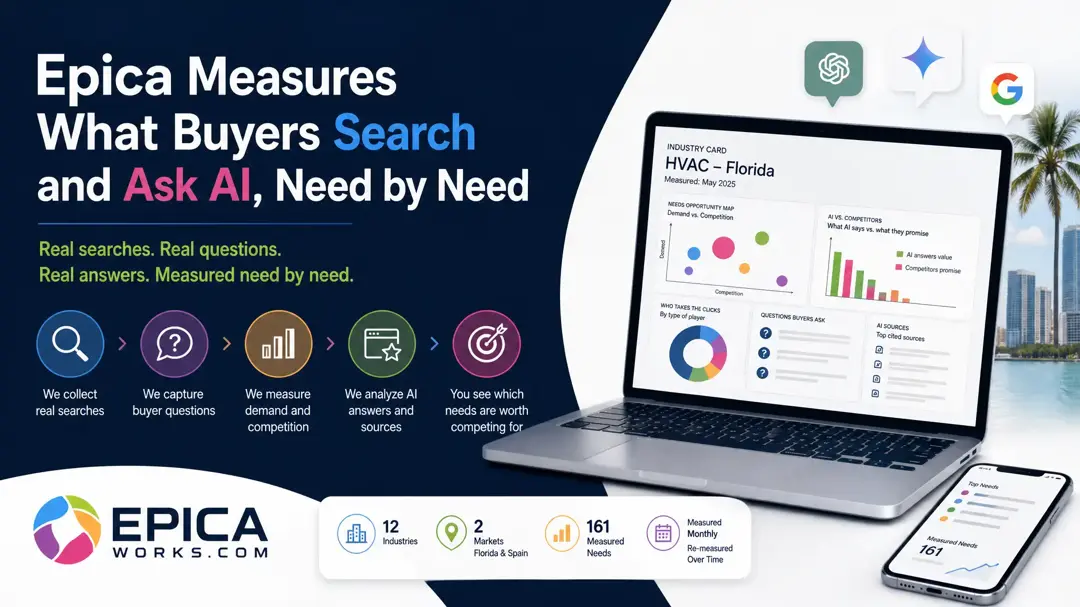
Epica is a database of what buyers search for on Google and ask ChatGPT, Gemini and Google AI Overviews, organized need by need for each industry. Every need is measured with real searches, dated, and re-measured over time. Today it holds 12 industry cards, 5 in Florida and 7 in Spain, with 161 measured needs between them. For a business, that means seeing which of its buyers' needs are worth competing for, and who wins them today.
Why need by need, and not keyword by keyword
Most marketing advice starts from a keyword list ranked by volume. That list hides the decision a business actually faces. A homeowner who types “AC repair near me” and one who asks “should I repair or replace my old AC?” are both HVAC buyers, but they need different answers, at different moments, from different pages.
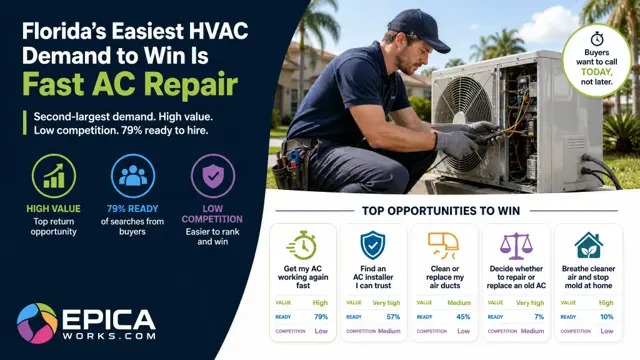
So Epica groups searches by the need behind them: “Get my AC working again fast when it breaks down”, “Decide whether to repair or replace an old AC”. Each need keeps the full set of phrases that express it, and each phrase counts for one need only, so the needs of an industry add up without double counting.
Volume alone also misleads. On our Spain security card, the largest demand is people who want to see their home cameras on their phone, and almost none of it is ready to hire anyone. A smaller need, such as complying with fire regulations at a business, carries far more value. Every need on a card therefore shows its demand, its value and how hard it is to win, side by side.
What we measure for every need
| Measure | Where it comes from |
|---|---|
| Searches and their trend over 12 months | Google Ads keyword data |
| The questions buyers ask | Google's “People also ask” and the AI engines |
| Who takes the clicks | Google's first page for every phrase |
| What AI answers say and which sources they cite | ChatGPT, Gemini and Google AI Overviews |
| What competitors promise | The titles that rank |
The last two rows are where the most useful finding usually sits: the gap between what AI answers explain to buyers and what businesses in the industry actually claim. On the Florida HVAC card, ChatGPT and Gemini answers mention warranty and reassurance in 20% of cases; first-page Google results claim it in 2%.
What an industry card shows
An industry card is the readable summary of an industry's needs in one market. It answers the question a business owner asks first, “how do businesses like mine win clients online?”, with the evidence underneath:
- the needs, with an opportunity map of demand against competition;
- the questions buyers ask;
- what AI answers value against what competitors promise;
- who takes the clicks, by type of player;
- the sources ChatGPT, Gemini and Google cite.
Every card states the month it was measured. No one pays to appear on a card or to look better on one: the cards show what Google and the AI engines recommend, whoever that is.
Why Florida and Spain
Each market is measured on its own. Florida's cards use Florida's searches and Florida's results; Spain's cards use Spain's. A need that matters in one market can be missing in the other, and the players who win are different, so a card is never a translation of another market's card.
What comes next
The cards are the public part of Epica. The same database will feed an AI agent that reads the needs of one specific business and turns them into a plan: which needs to compete for, what to publish and what to say. We are building it now, and new industries are being added to the database.
You can browse every published card in the industries directory.