Social media management pricing, and what you get for it
· 5 min read
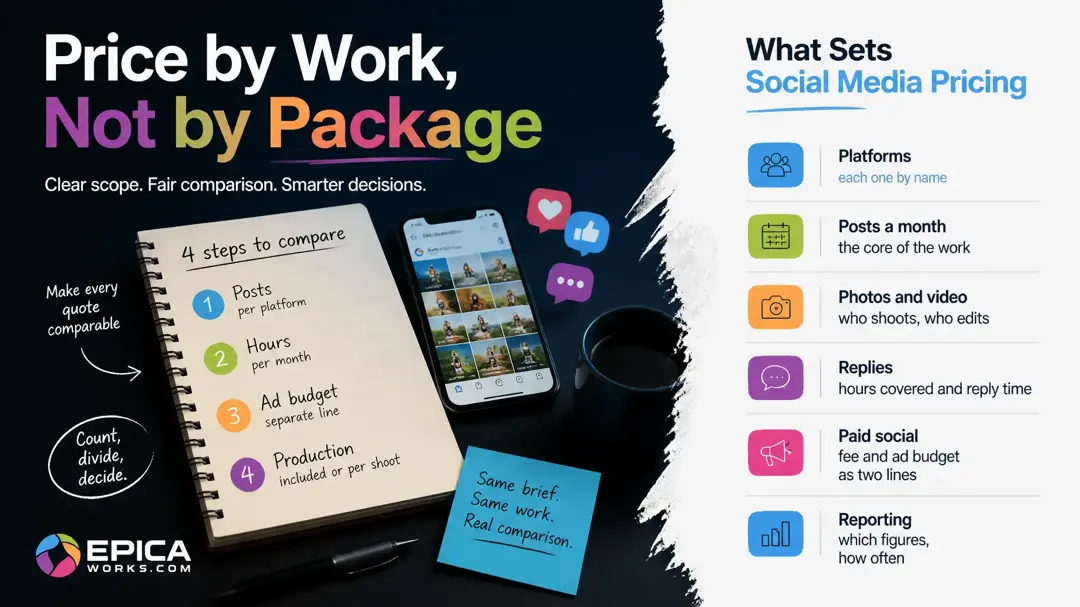
Social media management pricing turns on four things you can count: platforms, posts a month, reply time and who makes the photos, so price each quote by them. Divided into a price per post and per hour, two quotes ten times apart become comparable before you sign.
You probably have one figure from a freelancer and another from an agency, and neither says how many posts it buys. The steps below turn both into numbers you can hold side by side, then into a contract you can leave.
What the monthly fee actually buys
A quote for social media management is a bundle of separate jobs. Ask for each one as its own line, because the scope sets the price far more than the name of the package does.
| Line in the quote | Ask for | Why it moves the price |
|---|---|---|
| Platforms | each one by name | every platform needs its own sizes, captions and replies |
| Posts a month | the number per platform | the core of the work |
| Photos and video | who shoots, who edits | a shoot day costs more than a month of captions |
| Replies | hours covered and reply time | answering messages is daily work, weekends included or not |
| Paid social | the fee and the ad budget, two lines | the ad budget goes to Meta or TikTok, not to the provider |
| Reporting | which figures, how often | visits and messages tell you more than likes |
If a proposal leaves a line blank, write it in yourself and send it back as a question. A package called “growth” or “premium” with no post count is a price you cannot check.
Do it yourself, a freelancer or an agency
Doing it yourself costs your hours. The platforms' own tools carry most of the load: Meta Business Suite is where you create or schedule posts and stories for Facebook and Instagram and reply to messages from desktop or mobile. Put a price on that time before you call it free.
A useful yardstick is what an employee costs. The Bureau of Labor Statistics puts the median pay of market research analysts and marketing specialists at $37.87 an hour in May 2025, before payroll taxes and benefits. A freelancer billing close to that is charging roughly an employee's wage; a rate far below it usually buys less experience or less time on your account.
| Option | You pay | You get | Fits when |
|---|---|---|---|
| Yourself | your own hours each week | your voice, slower output | one or two platforms, one local area |
| Freelancer | a monthly fee or a price per post | posts and replies on one or two platforms | the plan works and the time is missing |
| Agency | a retainer, often with a minimum term | design, video, paid social, cover for holidays | you run paid social or several locations |
Paying anyone is the wrong move when your calls come from Google searches and the map. For a roofer or a dental practice whose phone rings from the Google Business Profile, the same money spent on photos and review requests there usually comes back sooner. Social media keeps past customers close; it rarely finds the first ones.
Turn every quote into a price per post and per hour
Take each quote and run the same four steps, on paper, before any call.
- Posts. Ask for the posts a month on each platform, add them up and divide the fee by the total.
- Hours. Ask how many hours a month the fee buys, divide again and set the result next to the $37.87 yardstick.
- Ad budget. Strip it out. If the quote folds ad spend into the fee, ask for the two lines separately.
- Production. Ask whether photos and video are included or billed per shoot, and add the shoots you expect.
Two made-up quotes show why.
Quote one is $1,200 a month for three platforms at 12 posts each: 36 posts, about $33 a post. Quote two is $600 a month for one platform at 8 posts: $75 a post. The cheaper monthly fee is the dearer one per post, and only the division shows it.
To check it worked, count the posts actually published at the end of the first month against the number you were quoted, platform by platform. Then check again every month the same way: the same count, the same visits and messages from your tagged links, compared with the month before and dated. A single good week proves nothing.
What is the 3-3-3 rule for social media?
There is no official definition. Marketing blogs describe it as three messages, three audiences and three channels; other versions say three platforms, three types of content and three goals. What every version shares is a ceiling, a way to stop a plan from spreading thin.
Use it to write the brief you hand a provider before you ask for a price. Write the three messages you want repeated (what you do, where, and why someone picks you), the customers you want to reach, and the channels they use. Three is the limit, not the target: a small business usually needs fewer.
The brief does two jobs on the quote. Anything priced outside your list, a third platform or a monthly video nobody asked for, is padding you can strike. And two providers quoting on the same brief are quoting the same work, which is the only fair comparison.
Before you sign the contract
Read three clauses before anything else: the minimum term, the notice period and who owns the photos and videos produced. A month-to-month agreement after a short trial lets you leave if the post count slips; a twelve-month lock-in with no exit makes the contract the product.
Keep the accounts in your name. Create each business page under your own login and add the provider as a user, so the page, its followers and its messages stay with you when the contract ends. Ask for the passwords to nothing: a provider that needs your personal login is a warning.
Paying a freelancer directly has paperwork. The IRS says a business must report payments to a non-employee for services on Form 1099-NEC once they total $2,000 in a calendar year, for payments made after December 31, 2025. Ask for a Form W-9 on day one rather than in January.
Settle the price last: first run the four checks of choosing marketing help on the result you need, the kind of help, the proposal and your starting point, because they decide whether any price is worth paying.
Before Friday, take the quote on your desk, write the posts a month and the hours next to the fee, and divide. If the provider cannot give you either number, that is your answer.