What local SEO services include and what they should cost
· 5 min read
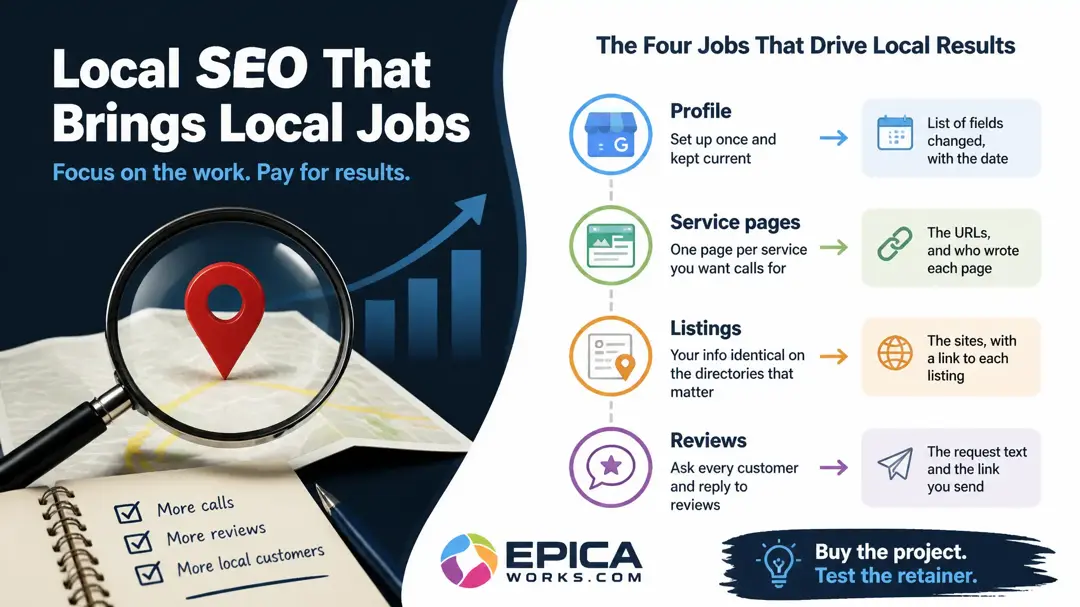
A local SEO service keeps your Google Business Profile, service pages, listings and reviews working for nearby searches, and its price should follow that work. Before you compare quotes, ask each one which of those four jobs it does, how many hours a month, and for which searches.
If the last provider sent a traffic graph every month and you still cannot say which calls it brought, the package was probably named after a result and never broke down into tasks. Read the next quote the other way round: tasks first, price last.
The four jobs a local SEO service should list
Google decides who shows on the map by relevance, distance and prominence, and its help page on how local ranking works says “There's no way to request or pay for a better local ranking on Google.” So a service cannot buy you a spot. What it can do is the work behind relevance and prominence, and a quote worth reading names it as four separate jobs:
| Job | What gets done | What you should receive |
|---|---|---|
| Profile | name, main category, address or service areas, hours, photos, set up once and kept current | the list of fields changed, with the date |
| Service pages | one page per service you want calls for, with the towns in its title and first lines | the URLs, and who wrote each page |
| Listings | your name, address and phone made identical on the directories and trade sites that matter in your area | the sites, with a link to each listing |
| Reviews | a way to ask every customer for a review as the job closes, and replies to the ones that come in | the request text and the link you send |
The first two are mostly a one-off project. The last two are where a monthly fee earns its keep, because listings drift and reviews only come in while someone keeps asking.
What moves the price, and how to set your ceiling
Price is driven by how many of those jobs the quote really does each month, how many towns or locations it covers, and how many pages need writing. A single location with a working website needs far less than a business with three branches and no service pages. A quote that charges the same either way is not pricing the work.
Work out your own monthly ceiling before you read any figure. Take what one new job leaves you after costs and multiply it by the extra jobs a month you want: if a job leaves you $400 and you want three more, $1,200 a month is the most that fees and any ad spend together can take before the work loses money. A quote over that line needs to show why it will bring more than three jobs.
Then turn each quote into hours. Ask for the hourly rate behind the fee, divide, and set the hours against the four jobs. A monthly fee that cannot be broken down this way tells you nothing about what it buys, whatever the package is called.
What no service should sell you
Some offers look like local SEO and put your profile at risk. Google's guidelines for representing your business say “Including unnecessary information in your business name isn't permitted” and warn that it could result in the suspension of your Business Profile. A provider that adds your town or “best” to the name on the map is spending your profile to look busy.
Reviews carry a legal line as well. The FTC's final rule on fake reviews bans buying and selling fake reviews, AI-written ones included, and lets the agency seek civil penalties against knowing violators. A package of “50 five-star reviews” is that offer, and so is paying customers only for a positive review, since the rule also prohibits incentives conditioned on what a review says.
Cross off any quote that promises a map position, writes keywords into your business name or sells reviews in bulk. Nobody can promise first place; ask for the tasks instead, and keep the profile, Search Console and analytics in your own Google account, with the provider added as a user.
When you don't need to pay for it
If you sell only online and never serve customers in an area, the map is not your channel and a local SEO service has nothing to work on. If your calendar is already full, wait: a complete profile and a review request after every job may be all the local marketing you need this season.
Google's own hiring advice adds a third case: “If you run a small local business, you can probably do much of the work yourself.” An owner with one location, a few services and an evening a week can do the profile and the reviews alone, and pay only for the service pages if writing is the part that stalls.
💡 Buy the project, test the retainer: pay for the profile and the service pages as a fixed project with an end date, then try the listings and reviews work on a three-month term before any yearly contract.
How to tell the service is working
Before the provider starts, write down where you stand: pick five searches a customer would type, each with your town, and note who appears on the map from the neighborhoods you want work in. Ask ChatGPT and Gemini the same questions logged out and note who they name. Date the page.
Each month, compare three things with that page: the calls and website clicks your profile reports, the names on the map for the same five searches from the same places, and the number of new reviews. Calls and reviews are the result you pay for; a ranking screenshot from the provider's own office is not, because distance changes what each searcher sees.
This week, ask every provider on your list for its quote split into the four jobs, with the hours behind each and the searches it targets by name. The one that answers in a table is the one to interview first; the guide to choosing marketing help lists what to ask in that interview.