Law firm SEO or dental SEO, do you need a specialist agency?
· 5 min read
A law firm or dental SEO specialist is worth paying only when it shows it knows your trade's advertising rules and the sites your clients trust before you sign.
If an agency already sold you “more traffic” and you still can't tell whether one new client came from it, a specialist label alone won't fix that. Test what the specialist knows in one call, then hire on that.
What a trade specialist should know on day one
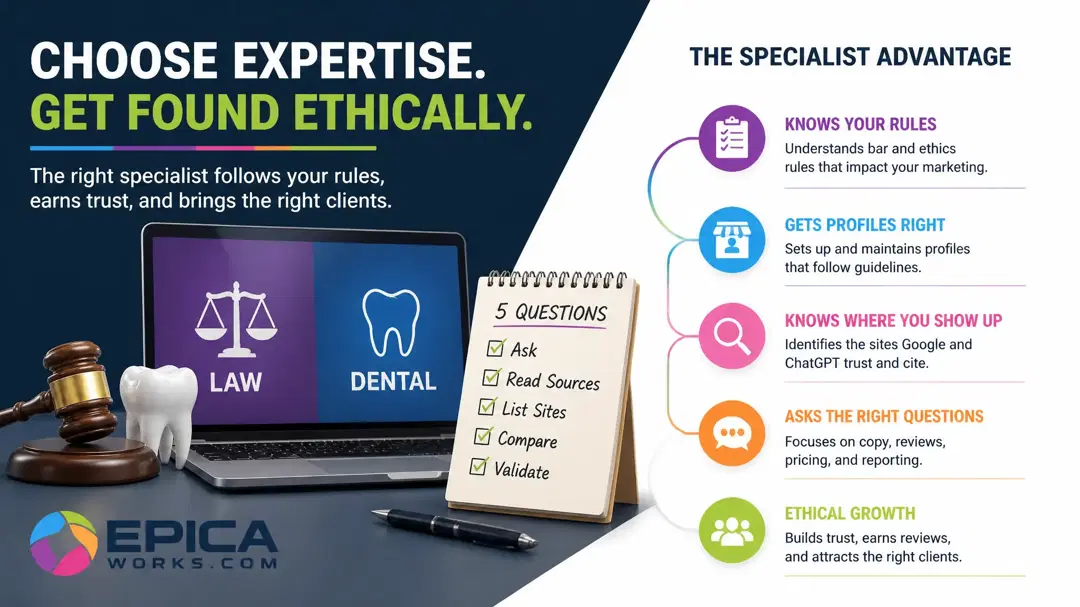
The real difference between a general agency and a law firm or dental one is not the tactics. It is the rules of your profession, which a general shop learns on your account, at your risk. Lawyers and dentists both answer to ethics rules that reach their website, their reviews and how they pay for marketing.
For lawyers, the state bar sets the limits. The Florida Bar's advertising checklist is a good example of what a specialist should recite without looking: no “prediction or guaranty of success or specific results”, no past results that are not objectively verifiable, testimonials only with a disclaimer that prospective clients may not get the same result, and “expert” or “specialist” only when the claim can be verified. Your own state's rules differ in detail; a specialist names them for your state.
For dentists, the American Dental Association's Code of Ethics has a section titled “Websites and Search Engine Optimization”. It says any SEO techniques used on a dentist's site should comport with the Code, and it reserves “specialist in” for the recognized specialties. It also treats paying a marketing vendor a percentage of the fees collected from the patients it brings as fee splitting, so a pay-per-patient deal is an ethics question before it is a pricing one.
Get the Google profile setup right first
Practices trip on Google's profile rules more often than on anything clever. Google's guidelines for representing your business cover individual practitioners: a lawyer or dentist who works in a public-facing role and can be reached at the office may have a profile of their own, but support staff should not, and a practitioner shouldn't have several profiles to cover each specialization.
When several practitioners share one office, the office gets its own profile and each practitioner's profile carries only the practitioner's name. A solo practitioner inside a branded practice shares one profile named “[brand]: [practitioner name]”. Adding extra words to the business name, such as “Best Injury Lawyer Tampa”, is not permitted and can get the profile suspended.
Check it worked: open each profile, compare the name with the sign on your door and your website, and remove any duplicate profile left by a past hire. A specialist should ask about this in the first call, because a suspended profile costs more calls than any page it writes.
Run your own five questions before the call
Before you speak to anyone, do the measuring yourself. Logged out, ask ChatGPT and Gemini five questions a client or patient would ask, with your town in each: “best DUI lawyer in Tampa”, “emergency dentist open Saturday near Plano”. Write down which practices each answer names and, more useful, the sites each answer cites.
Then read those sources, not only the names. Drop the government pages and your competitors' own sites; what is left (a legal or dental directory, a bar or dental association listing, a review site, local press) is where your practice can get listed this month. One answer is one draw, so ask each question twice and date the page.
Now you hold a list the agency has to beat. In the call, ask which sites Google and ChatGPT lean on for your practice area in your town. A real specialist names some of yours without notes; a general agency tends to answer with a services menu.
Ten minutes of questions that sort them
Ask every agency the same questions and write down the answers. A specialist's answers are specific to your trade; a reseller of a generic package gives the same answers to a roofer.
| Ask | A specialist answers | Walk away if |
|---|---|---|
| Who checks copy against my bar or ethics rules? | A named person, before anything goes live | “We write it, you approve it” |
| How do you handle reviews? | Asks every client or patient, never pays for them | Offers to buy or filter reviews |
| How do you price? | A flat monthly fee for named tasks | A cut of fees per new client or patient |
| What would you fix first? | Your profile setup or a missing service page | “Content” or “backlinks”, with no page named |
| Whose name are the accounts in? | Yours, with them added as users | Theirs |
| What will you report? | Calls, forms and bookings | Rankings and visits only |
The pricing row matters most for dentists, because of the fee-splitting rule above. For lawyers, the copy row does: a page that promises results can bring a bar complaint, not just a slow month.
When a general agency or doing it yourself is enough
A specialist is not for every practice. If you are a solo dentist or a one-office firm in one town, your profile is complete, and a dozen recent reviews already sit on it, most of the gain is in doing a few tasks well: one page per service you want more of, written in the words clients use on the phone, and a review request after every finished case or visit.
A good general agency can do that, provided you hold it to the profession's rules yourself. Hand it your state bar's advertising rules or the ADA Code on day one, and keep the final read of every page.
Take the second half of this week to run the five questions, list the sites cited and compare them with the law firm card or the dental practice card, which show who Google and ChatGPT recommend in your trade today. Any agency you call next has to explain how it gets you onto that list.