What Google Ads cost you in ad spend and management
· 5 min read
Google Ads costs your daily budget, never more than 30.4 times it a month, plus any manager's fee; $500 covers only a short list of local searches. Whether it pays back is a sum you can do tonight with Google's bid ranges and what one job earns you.
What you pay Google, and what caps it
Google never sends you a monthly price. You set an average daily budget for each campaign and pay for the clicks it buys. Google's page on overdelivery and your average daily budget says that “on a given day, your campaign might spend up to twice your average daily budget,” and that “at the end of the month, you will have spent no more than 30.4 times your average daily budget.”
So turn your monthly figure into a daily one before you type anything. $500 a month is a daily budget of about $16.45, which is $500 divided by 30.4. Type $500 into the daily field by mistake and the same month can reach $15,200.
A day that spends $30 on a $16.45 budget is not a fault in the account. The monthly cap is what protects you, so judge the spend on the invoice at the end of the month, not on one busy Tuesday.
Price one click before you pick a budget
The number that decides the rest is what one click costs on the searches that bring you jobs, and Google shows you a range for it before you spend a cent.
In Google Ads, open Tools, then Planning, then Keyword Planner, choose “Get search volume and forecasts”, and paste five phrases a customer types right before calling you. Put your town in each one: “emergency plumber Tampa”, not “plumbing”. Set the location to the area you actually serve.
Those five phrases come from the habit we use when we measure who gets recommended in a trade: ask the way your customers do, in their words, with the town included. A list built from your own service names (“residential solutions”, “full service maintenance”) prices searches nobody types.
Then read two columns. Google's page about Keyword Planner forecasts defines the top of page bid (low range) as roughly the 20th percentile of what advertisers have historically paid for a top of page bid, and the high range as roughly the 80th percentile, both “based on your location and Search Network settings.” Plan on the high range: a new account with no history rarely buys the top slot at the cheap end.
Divide your monthly ad money by that high range and you have the clicks your budget buys:
| If the high range reads | $500 a month buys about |
|---|---|
| $5 | 100 clicks |
| $10 | 50 clicks |
| $25 | 20 clicks |
Those rows are arithmetic, not a forecast for your trade; the figure that counts is the one Keyword Planner shows for your own five phrases and your own area. If a phrase shows no bid range at all, Google has too little bid history for it, and you can leave it in the list without counting on it.
Is $500 a month enough for Google Ads?
It is enough when it buys a fair number of clicks on one or two services in one area, and too little when it is spread over everything you sell. The test is a second division: what one booked job earns you after costs. If a job leaves you $250, then $500 of ads pays back with two jobs, so one click in every 25 has to turn into a paying job when the high range is $10.
Look at that ratio and decide whether it is believable for your business. A trade where one call usually becomes a job (an emergency repair, a lockout) can live with it. A trade where people collect three quotes before choosing needs far more calls per job, and then $500 either goes to the single service with the best margin or waits.
$500 is the wrong budget in three cases:
- The high range on your main search is so high that $500 buys a handful of clicks a month: too few to tell a bad week from a bad ad.
- Calls from ads are not counted as conversions yet, so the account can only show you clicks; set that up first.
- Your calendar is already full from referrals and your Google Business Profile, which cost nothing.
Narrowing beats spreading. One service, the towns you can reach in a morning, and the hours you can pick up the phone will usually do more with $500 than five services across a county.
What a management fee should buy
The fee and the spend are two different bills, and Google makes the people who manage ads for others say so. Its transparency requirements for third parties state: “If you charge a management fee (separate from the cost of Google Ads or AdWords Express), you must clearly inform customers.” Cost reports must also “report the exact amount charged by Google, exclusive of any fees that you charge.”
So every proposal and every invoice should show two lines: what Google charged and what the manager charged. Proposals price the management fee in one of three ways, sometimes mixed:
- A flat monthly fee: the easiest to compare, and the usual fit for a small budget that will not grow soon.
- A percentage of ad spend: the fee rises whenever the spend does, so ask who decides to raise the budget and why.
- A setup fee: fair when it pays for real work (tracking calls, building the campaign around your five phrases), and worth asking about line by line when it does not.
Ask what the fee buys each week, in tasks: reading the searches that triggered your ads, blocking the ones that never buy, checking which calls came from the ads. If the fee comes out of the same $500, fewer dollars reach the clicks; run the division from the last section again with what is left.
Write your three lines before anyone quotes you
Put the whole cost on one sheet, with your own figures:
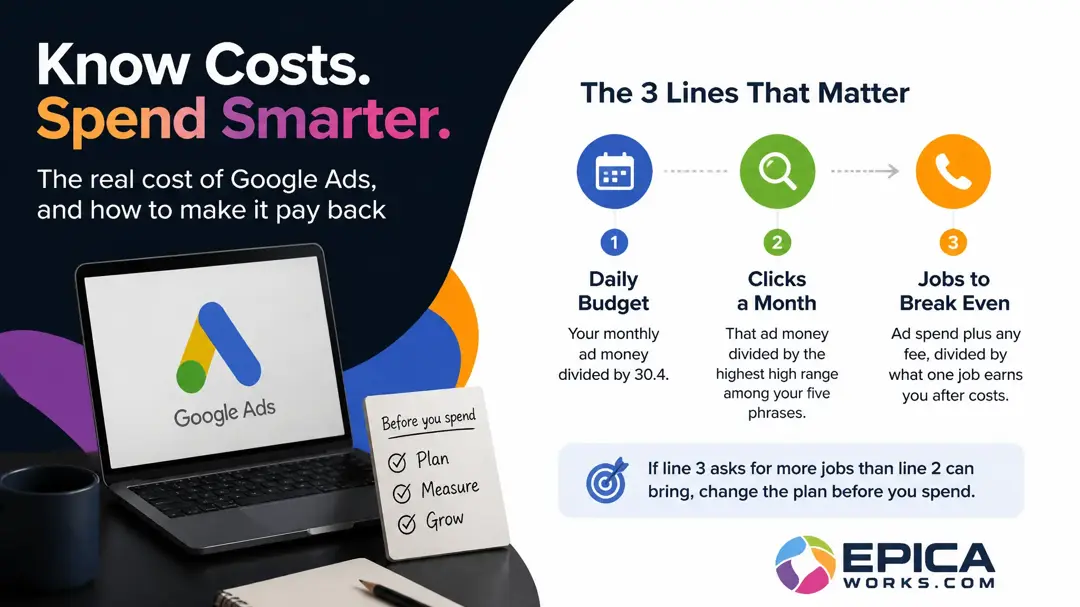
- Daily budget: your monthly ad money divided by 30.4.
- Clicks a month: that ad money divided by the highest high range among your five phrases.
- Jobs to break even: ad spend plus any fee, divided by what one job earns you after costs.
If line 3 asks for more jobs than line 2 can plausibly bring, change the plan before you spend: fewer services, a smaller area, or a higher budget for one season. A provider who reads your three lines and cannot say which of them their work changes has not quoted you a service yet.
Tonight, open Keyword Planner with your five customer phrases and your town, and fill line 2. When you take the sheet to a freelancer or an agency, step 3 of choosing marketing help lists what the proposal should name beside those numbers.