How a small business starts a content marketing strategy
· 5 min read

A small business starts content marketing by answering the questions customers ask before they buy, one page each, beginning with the question heard most often. Write the strategy down in three lines first, publish at a pace you can hold for a year, and judge it by searches and calls.
You run the business, so content gets the evenings that are left. The usual advice (post every day, start a blog, be everywhere) assumes a team you do not have. The order below assumes one person with a phone full of customer questions and a few hours a month.
What content marketing means for a business your size
For a roofer, an accountant or a dental clinic, content marketing is publishing the answers a buyer looks for before choosing who to call: what the job costs, how long it takes, what to check before hiring, whether to repair or replace. A buyer who types one of those questions into Google or ChatGPT gets somebody's answer. The work is making that answer yours, on your own site, in words your customers use.
It is not a social feed you have to feed daily, and it is not a blog for its own sake. A page that answers one real question keeps working while you are on a job; a post written because “we should post something” rarely brings a single call.
Who can skip this for now: if a handful of known accounts fill your calendar, or every job comes by referral, a page per service and a complete Google Business Profile do most of the work. Content pays when buyers who have never heard of you are searching for what you do.
Write the strategy in three lines before any page
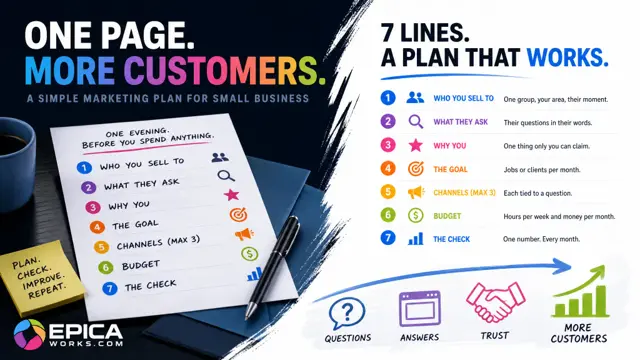
A content marketing strategy for a small business fits on one sheet. Write three lines:
- Who: one kind of buyer, described the way you would describe them to a new hire (“homeowners in the county with a roof over 15 years old”).
- Which questions: the ten you hear most by phone, by email and on quote visits, in the customer's words.
- What they do next: the one action you want after they read (call, request a quote, book a visit).
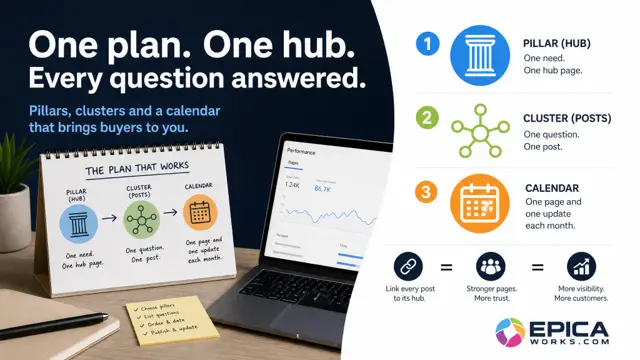
Check it: hand the sheet to someone outside the business. If they can tell who you serve and which page you would write first, the strategy is done. Turning those ten questions into a calendar and grouping them by topic is the next job, once the first pages exist; a wider marketing plan, with budget and channels, is a separate one.
Take the questions from where customers already speak, not from a keyword tool. The tool comes later, to check the words people type; if you want to see the questions buyers in your line of work ask before they hire, the trade cards list them by sector, with the month they were measured.
Start with the question you hear most by phone
The question customers ask most often by phone gets the first page. Title it with the question in their words and answer it in the first two sentences, the way you would answer on the phone. Then add what only you can give: your price range, the area you cover, how long the job takes, photos of real jobs with a line under each.
Put all of it in page text. Prices inside an image or a PDF are invisible to the systems that read your page, and they are the details a buyer compares. Google's own guidance on writing for people rather than for search engines asks the question every page should pass:
After reading your content, will someone leave feeling they've learned enough about a topic to help achieve their goal?
Check it worked: read the first two sentences aloud to someone who has never hired you. If they could act on them without reading on, the page answers. The rest of the order (keeping only the searches your buyers type, picking the ones you can win) is laid out step by step in the guide to what to publish.
How much to publish when you also run the business
Pick a pace you can keep for twelve months, not one you can keep for a month. One page a month is twelve answers by this time next year, each one still working; a burst of ten pages followed by silence leaves ten pages nobody updates. Rewriting an old page so it answers better counts as that month's page.
Publish in this order, because each row brings buyers closer to calling than the one below it:
| Order | What to publish | Why it comes here |
|---|---|---|
| First | One page per service, with a clear title, your area and your price range | Buyers ready to hire land here |
| Second | The question you hear most by phone | It is asked before the call, every week |
| Third | The cost question for your main job | Buyers price the job before they ring |
| Fourth | The choice customers weigh (repair or replace, this material or that) | They decide here, and then compare who does it |
| Later | Social posts and newsletters that point back to those pages | They spread answers you already have |
💡 Keep a question log: make a note on your phone called “questions” and add every question a customer asks, the day they ask it. After a month the list sorts itself: the one written down most often is your next page.
How to tell whether it brings clients
Give each page three months before you judge it. Then open Search Console's Performance report, switch to the Pages tab, click the page and read the Queries tab: those are the searches that showed it, with impressions (how often it appeared) and clicks. A page with impressions and few clicks exists but does not convince; rewrite its title and first sentence before you write anything new.
Search results are only half of it. Once a month, ask ChatGPT and Gemini, logged out, the same five customer questions with your town in them, and write down who gets named and which sites are cited. One answer is one draw: repeat each question and date every reading, so next month you compare against a record rather than a memory.
The third check costs nothing. When a new customer calls, ask what they read before calling, and which page. “Online” covers Google, Maps and ChatGPT, so ask once more until you know which.
Your first task fits on an index card: the three lines of the strategy on the front, the question you heard most this week on the back. Answer that question in two sentences, as you would on the phone, and send them to the last customer who asked it; if they would forward your answer to a friend, it is ready to become your first page.